Picture Description for Kids: Fun Learning Through Observation
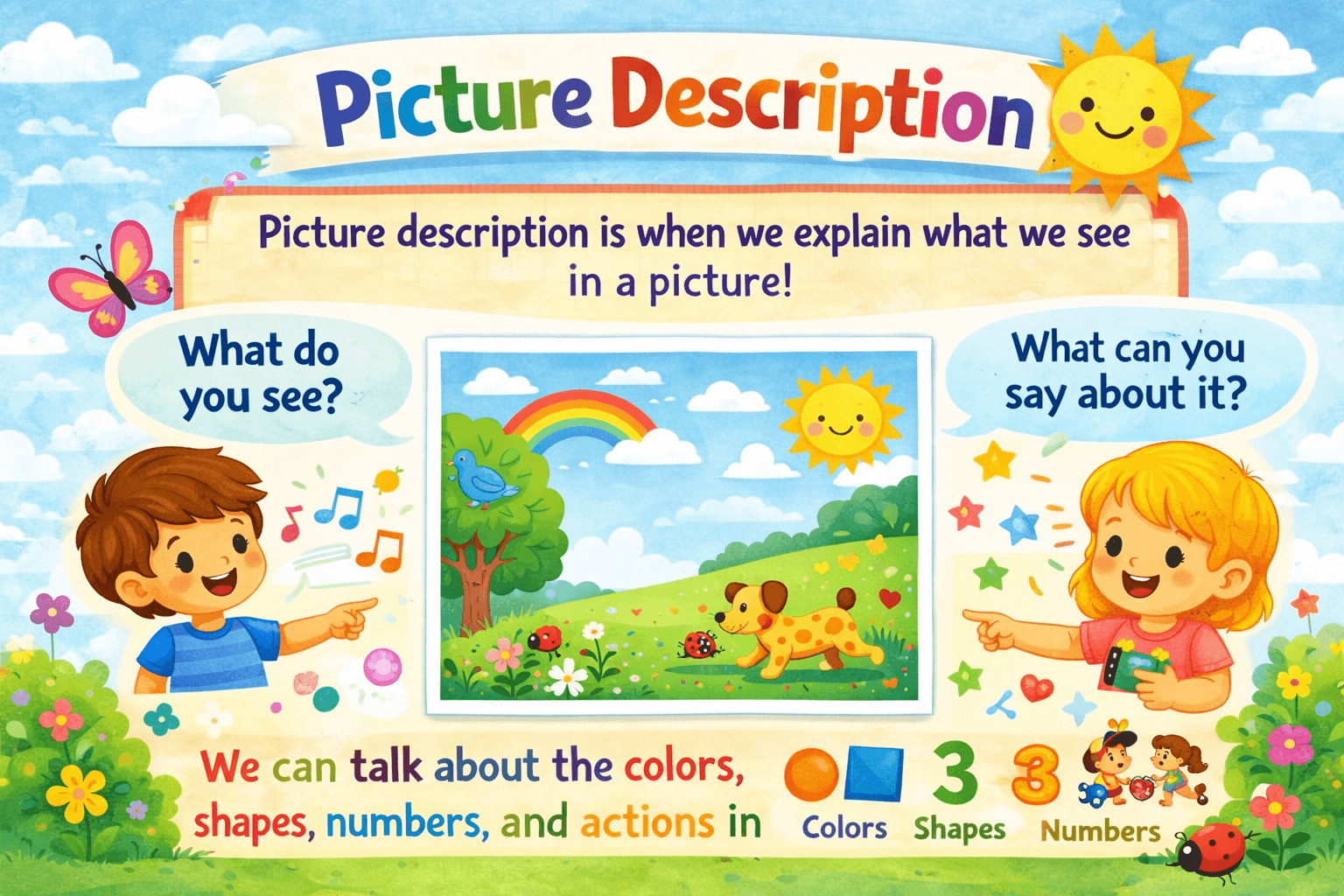
Learning to describe pictures helps kids improve vocabulary, speaking skills, and creativity. It also strengthens reading comprehension and critical thinking. This activity is perfect for early learners and elementary students.
Loading cards...
🎯 Objectives
By the end of this activity, kids will be able to:
Identify objects, people, animals, and actions in pictures.
Use descriptive words and simple sentences.
Ask and answer questions about pictures.
Enhance imagination and storytelling skills.
🖼️ How to Do Picture Description
Step 1: Observe the Picture
Look carefully at the picture. Notice:
Who is in the picture?
What are they doing?
Where is the scene happening?
When might this be? (morning, afternoon, night)
Why might this be happening?
Step 2: Describe What You See
Start with simple sentences:
“The cat is sleeping on the sofa.”
“A boy is playing football in the park.”
“The sun is shining brightly in the sky.”
Step 3: Ask Questions About the Picture
“What is the girl holding?”
“Why is the dog running?”
“Where are the birds flying?”
Step 4: Make a Story
Combine sentences into a short story:
“It is a sunny day. A boy is playing football. His dog is running after the ball. They are having so much fun!”
🧩 Interactive Activities
1. Fill-in-the-Blank Sentences
Example Picture: A park with children and animals.
Activity:
“The ___ is flying in the sky.” → (Answer: bird)
“The boy is ___ a ball.” → (Answer: kicking)
2. Multiple Choice Questions
Example Picture: A kitchen scene.
“What is the girl doing?”
(A) Sleeping
(B) Cooking
(C) Reading
Answer: B
3. Match the Description
Match the sentences to the correct part of the picture.
Sentence: “The cat is sleeping on the bed.”
Picture: Kid points to the cat. ✅
4. Story Sequencing
Cut the picture into small sections or stages. Ask kids to arrange the pictures in order and describe each step.
💡 Tips for Parents and Teachers
Start with simple pictures with 2–3 objects or actions.
Encourage complete sentences, not just single words.
Praise creativity, even if the description is imaginative.
Repeat regularly for vocabulary reinforcement.
✨Examples!
1. Park Picture
Example: “A boy is flying a kite in the park.”
Explanation: This sentence describes who is in the picture and what he is doing.
2. Classroom Picture
Example: “The teacher is writing on the board while the students are listening.”
Explanation: This sentence tells the action happening in the classroom.
3. Beach Picture
Example: “Two children are building a sandcastle near the sea.”
Explanation: This sentence explains the activity and the place in the picture.
4. Farm Picture
Example: “A farmer is feeding the chickens on the farm.”
Explanation: This sentence describes a person and the animals in the picture.
5. Kitchen Picture
Example: “A girl is helping her mother cook dinner in the kitchen.”
Explanation: This sentence shows the people and their action in the picture.
6. Playground Picture
Example: “The children are playing on the swings and slide.”
Explanation: This sentence describes what the children are doing in the playground.
References
- Clark, C., & Paivio, A. (2016). Pictures and Learning: Enhancing Vocabulary in Children. Journal of Educational Psychology, 108(3), 345–357.
- Nation, I. S. P. (2013). Learning Vocabulary in Another Language. Cambridge University Press.
- Education Corner. “Picture Description Activities for Kids.” https://www.educationcorner.com/picture-description-activities.html