Prepositions for Kids (Fun and Interactive!)
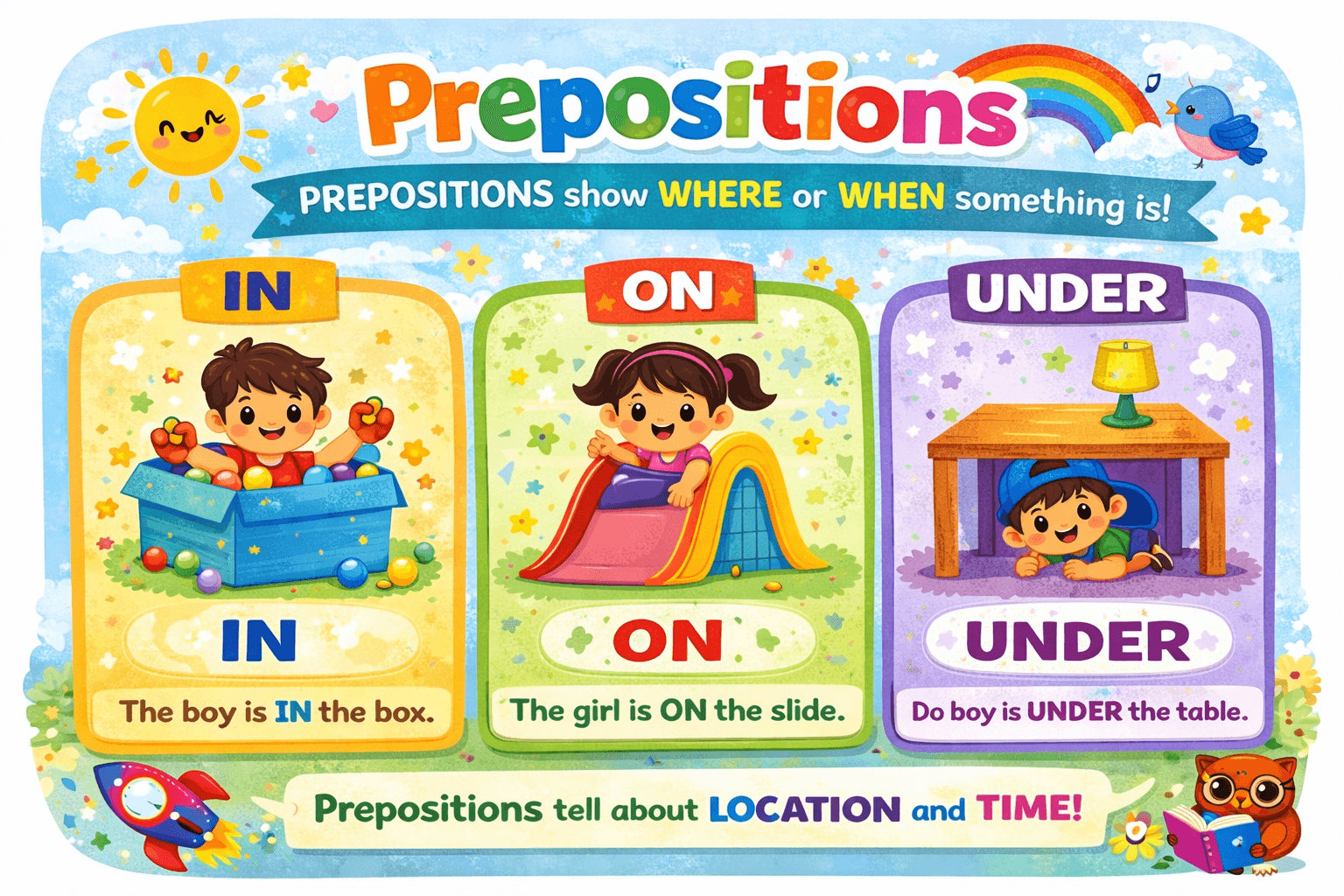
📚 Learning prepositions helps kids explain where, when, or how something happens. Let’s explore them in a fun and simple way!
Loading cards...
🌟 What is a Preposition?
A preposition is a word that shows the relationship between a noun or pronoun and another word in the sentence. It often tells us about place, time, or direction.
Examples of prepositions are: in, on, under, beside, between, behind, at, and near.
Example sentences:
The cat is under the table.
The book is on the desk.
The ball rolled behind the chair.
📍 Common Prepositions of Place
| Preposition | Example | Explanation |
|---|---|---|
| In | The toy is in the box. | The toy is inside the box. |
| On | The cat is on the chair. | The cat is sitting on top of the chair. |
| Under | The puppy is under the table. | The puppy is below the table. |
| Beside | The bag is beside the desk. | The bag is next to the desk. |
⏰ Common Prepositions of Time
| Preposition | Example | Explanation |
|---|---|---|
| At | The party starts at 3 PM. | It tells the exact time. |
| On | We have class on Monday. | It tells the day. |
| In | My birthday is in July. | It tells the month or year. |
🎮 Interactive Activity 1: Fill in the Blank
Choose the correct preposition: in, on, under, beside
1. The cat is ______ the table.
2. The pencil is ______ the desk.
3. The ball is ______ the box.
4. The dog is ______ the chair.
👉 Answers:
1. under
2. on
3. in
4. beside
🎮 Interactive Activity 2: Look Around!
Ask kids to look around the room and say sentences using prepositions.
Example:
The clock is on the wall.
My bag is under the chair.
The book is in my backpack.
This helps children connect grammar to real life.
🎮 Interactive Activity 3: Move and Learn
Ask kids to follow instructions:
1. Put your pencil on the table.
2. Put your hand under the chair.
3. Stand beside your desk.
This activity helps kids learn by doing.
✨ Quick Tip for Kids
Remember:
Prepositions tell where or when something happens!
Example:
The cat is on the mat.
The game starts at noon.
More examples!
In – The toy is in the box.
Explanation: This shows the toy is inside the box.
On – The book is on the table.
Explanation: This shows the book is on top of the table.
Under – The cat is under the chair.
Explanation: This shows the cat is below the chair.
Beside – The dog is beside the boy.
Explanation: This shows the dog is next to the boy.
Between – The ball is between the two boxes.
Explanation: This shows the ball is in the middle of the two boxes.
Behind – The girl is behind the tree.
Explanation: This shows the girl is at the back of the tree.
At – We will meet at the park.
Explanation: This shows the specific place where we will meet.
Near – The school is near the library.
Explanation: This shows the school is close to the library.
References
- Cambridge University Press. (2019). Cambridge Primary English Learner’s Book. Cambridge University Press.
- British Council. (2023). Prepositions for Children. LearnEnglish Kids.
- Oxford University Press. (2020). Oxford Discover Grammar Level 1. Oxford University Press.