Direct and Indirect Speech for Kids
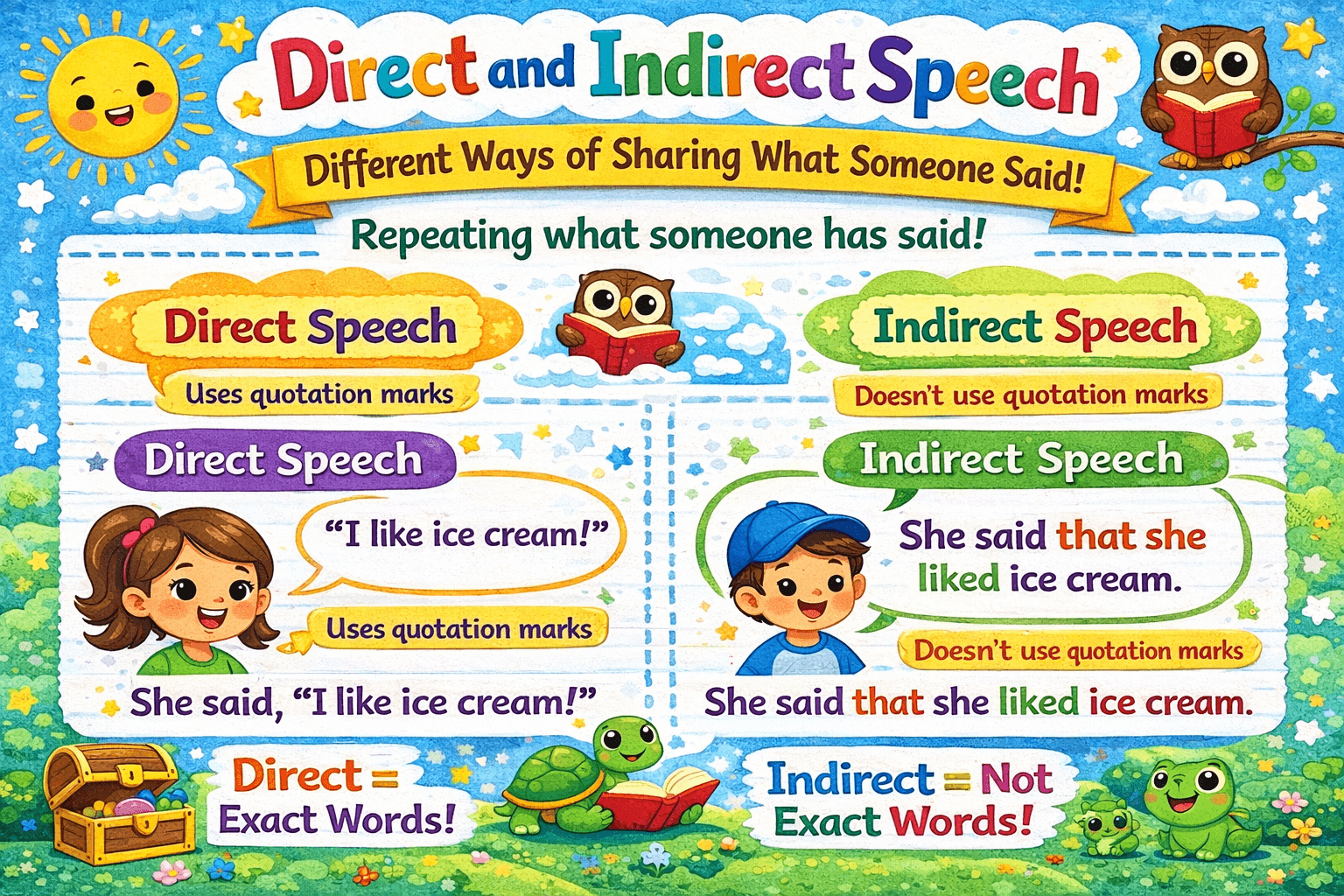
Learning how to tell what someone said is an important part of writing and speaking! This is called Direct Speech and Indirect Speech. Let’s learn how they work in a fun and simple way.
Loading cards...
What is Direct Speech? 💬
Direct speech tells the exact words someone said. We use quotation marks (" ") to show the exact sentence.
Example:
Mia said, “I love ice cream!”
Here, the sentence inside the quotation marks shows the exact words Mia said.
What is Indirect Speech? 🗨️
Indirect speech tells what someone said, but not the exact words. We usually remove quotation marks and change the sentence slightly.
Example:
Mia said that she loved ice cream.
The meaning is the same, but the words are reported differently.
Direct vs. Indirect Speech Example
| Direct Speech | Indirect Speech |
|---|---|
| Leo said, "I am tired" | Leo said that he was tired |
| Anna said, "I like reading books" | Anna said that she liked reading books |
| Tom said, "I will play soccer" | Tom said that he would play soccer |
Fun Tip ⭐
When changing direct speech to indirect speech, we often:
Remove quotation marks
Add that
Change pronouns (I → he/she)
Sometimes change verb tense
Example:
Direct:
Sara said, “I am happy.”
Indirect:
Sara said that she was happy.
🎮 Interactive Activity 1: Direct or Indirect?
Read the sentences and decide if they are Direct Speech or Indirect Speech.
1. Ben said, “I lost my pencil.”
2. Lily said that she was going to the park.
3. Dad said, “Clean your room.”
4. My teacher said that the test would be tomorrow.
Answers
1. Direct
2. Indirect
3. Direct
4. Indirect
✏️ Interactive Activity 2: Change the Sentence
Turn the Direct Speech into Indirect Speech.
1. Emma said, “I like pizza.”
2. Jack said, “I am playing outside.”
3. Mom said, “Dinner is ready.”
Possible Answers
1. Emma said that she liked pizza.
2. Jack said that he was playing outside.
3. Mom said that dinner was ready.
🧠 Quick Challenge
Fill in the blank!
Direct:
“I finished my homework,” said Liam.
Indirect:
Liam said that he ______ his homework.
✅ Answer: had finished
Why is Direct and Indirect Speech Important?
It helps us:
Tell stories clearly 📖
Report conversations 🗣️
Write better essays ✍️
Writers and speakers use these skills every day!
References
- British Council – Learning English Grammar https://learnenglish.britishcouncil.org
- Cambridge University Press – English Grammar Resources https://dictionary.cambridge.org/grammar
- Oxford University Press – English Learning for Children https://www.oxfordlearnersdictionaries.com