Introduction to Multiplication: Adding Groups Together
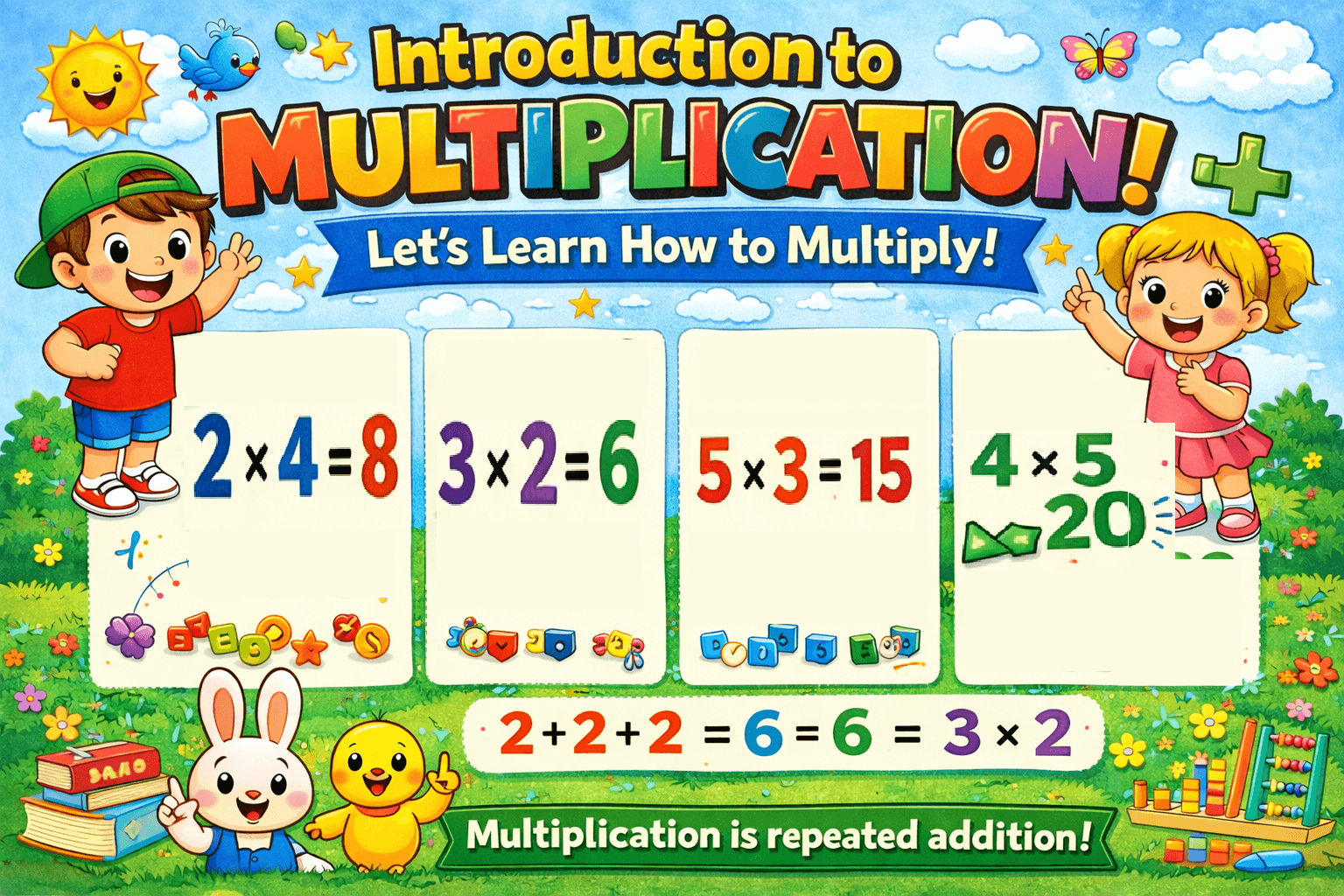
As children learn more about numbers, they discover that there is a faster way to add the same number many times. This is called multiplication. Multiplication helps us count groups quickly and easily. For example, if you have 3 baskets with 4 apples each, instead of adding 4 + 4 + 4, you can use multiplication to find the answer faster.
Loading cards...
What Is Multiplication? 📚
Multiplication is the process of adding equal groups together. It helps us find the total number of items when the same number is repeated several times.
Parts of a Multiplication Problem 🔍
A multiplication sentence has three parts:
Example:
3 × 4 = 12
● 3 → Multiplicand → number of groups
● 4 → Multiplier → number in each group
● 12 → Product → total or product
The answer in multiplication is called the product.
Multiplication as Repeated Addition ➕
Multiplication can be shown as repeated addition.
Example:
2 × 5
This means 2 groups of 5.
5 + 5 = 10
So:
2 × 5 = 10
Example with objects:
🍪🍪🍪
🍪🍪🍪
Two groups of three cookies.
2 × 3 = 6 cookies
Let’s Practice Multiplication! 🎯
1. Count the Groups
🍎🍎
🍎🍎
🍎🍎
There are 3 groups of 2 apples.
3 × 2 = 6
2. Use Repeated Addition
4 × 3
3 + 3 + 3 + 3 = 12
Answer: 12
3. Look at the Objects
⭐⭐⭐
⭐⭐⭐
Two groups of three stars.
2 × 3 = 6
Why Learning Multiplication Is Important 🌟
Multiplication helps children:
● Count groups quickly
● Solve larger math problems
● Prepare for division and advanced math
The National Association for the Education of Young Children suggests using visual objects and hands-on activities to help children understand multiplication concepts.
Conclusion
Multiplication is a helpful way to add equal groups quickly. By understanding multiplication as repeated addition, children can easily find the total number of items in groups. With practice and fun activities, multiplication becomes an exciting part of learning math.
References
- National Council of Teachers of Mathematics. (2000). Principles and Standards for School Mathematics.
- National Association for the Education of Young Children. (2020). Developmentally Appropriate Practice in Early Childhood Programs.
- UNESCO. (2016). Early Childhood Care and Education Learning Framework.