Learning to Tell Time and Use Money
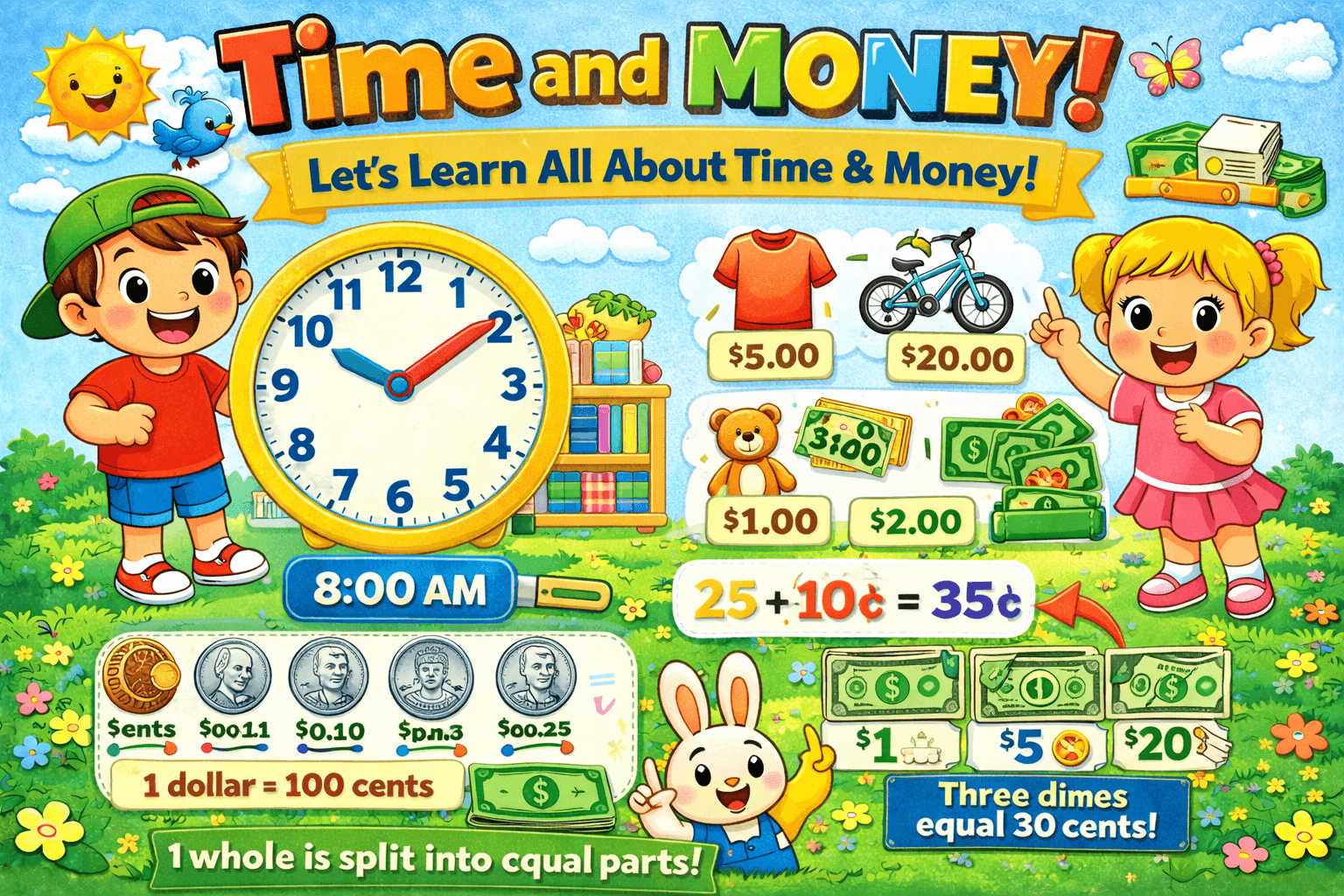
Two important skills children learn in everyday life are telling time and understanding money. These skills help children manage daily activities, such as knowing when it is time for school, playtime, or bedtime. Learning about money also helps children understand how we buy things and save money. By learning about time and money, children begin to see how math is used in real-life situations.
Loading cards...
Understanding Time ⏰
Time helps us know when things happen and how long something lasts. We often use a clock to tell time.
A clock usually has two hands:
Hour hand – shows the hour
Minute hand – shows the minutes
Example:
🕒 When the hour hand points to 3 and the minute hand points to 12, the time is 3:00.
Children often learn time through daily activities like:
● Waking up in the morning
● Going to school
● Eating lunch
● Going to bed
Units of Time 🔍
Here are some basic time units:
60 seconds = 1 minute
60 minutes = 1 hour
24 hours = 1 day
Example daily schedule:
Activity ----------- Time
Wake up --------- 7:00 AM
Go to school ---- 8:00 AM
Lunch time ------ 12:00 PM
Bedtime ---------- 9:00 PM
Understanding Money 💰
Money is used to buy things like food, toys, and school supplies. Money comes in the form of coins and paper bills.
In the Philippines, money is called Philippine Peso (₱) and is used throughout the country.
Examples of common coins:
₱1 coin
₱5 coin
Examples of bills:
₱20 bill
₱100 bill
Money in the Philippines is issued by the Bangko Sentral ng Pilipinas, which manages the country’s currency.
Let’s Practice Time and Money! 🎯
1. What Time Is It?
If the clock shows:🕒
Hour hand on 3 and minute hand on 12.
The time is 3:00. Note: 12 on the minute hand is equivalent to :00
2. Counting Money
If you have: ₱5 + ₱5 + ₱10
Total money: ₱20
3. Buying Items
If a toy costs ₱10 and you have ₱20, do you have enough money?
Answer: Yes! You still have ₱10 left.
Why Learning Time and Money Is Important 🌟
Understanding time and money helps children:
● Manage their daily schedule
● Learn responsibility and planning
● Understand basic financial concepts
Educational organizations such as the National Council of Teachers of Mathematics emphasize that real-life math skills help children apply mathematics in everyday situations.
Conclusion
Time and money are important parts of everyday life. Learning how to read a clock and understand money helps children become more independent and confident in handling daily activities. With practice and real-life examples, kids can easily develop these useful skills.
References
- National Council of Teachers of Mathematics. (2000). Principles and Standards for School Mathematics.
- National Association for the Education of Young Children. (2020). Developmentally Appropriate Practice in Early Childhood Programs.
- UNESCO. (2016). Early Childhood Care and Education Learning Framework.