Basic Addition: Learning to Add in a Fun and Simple Way
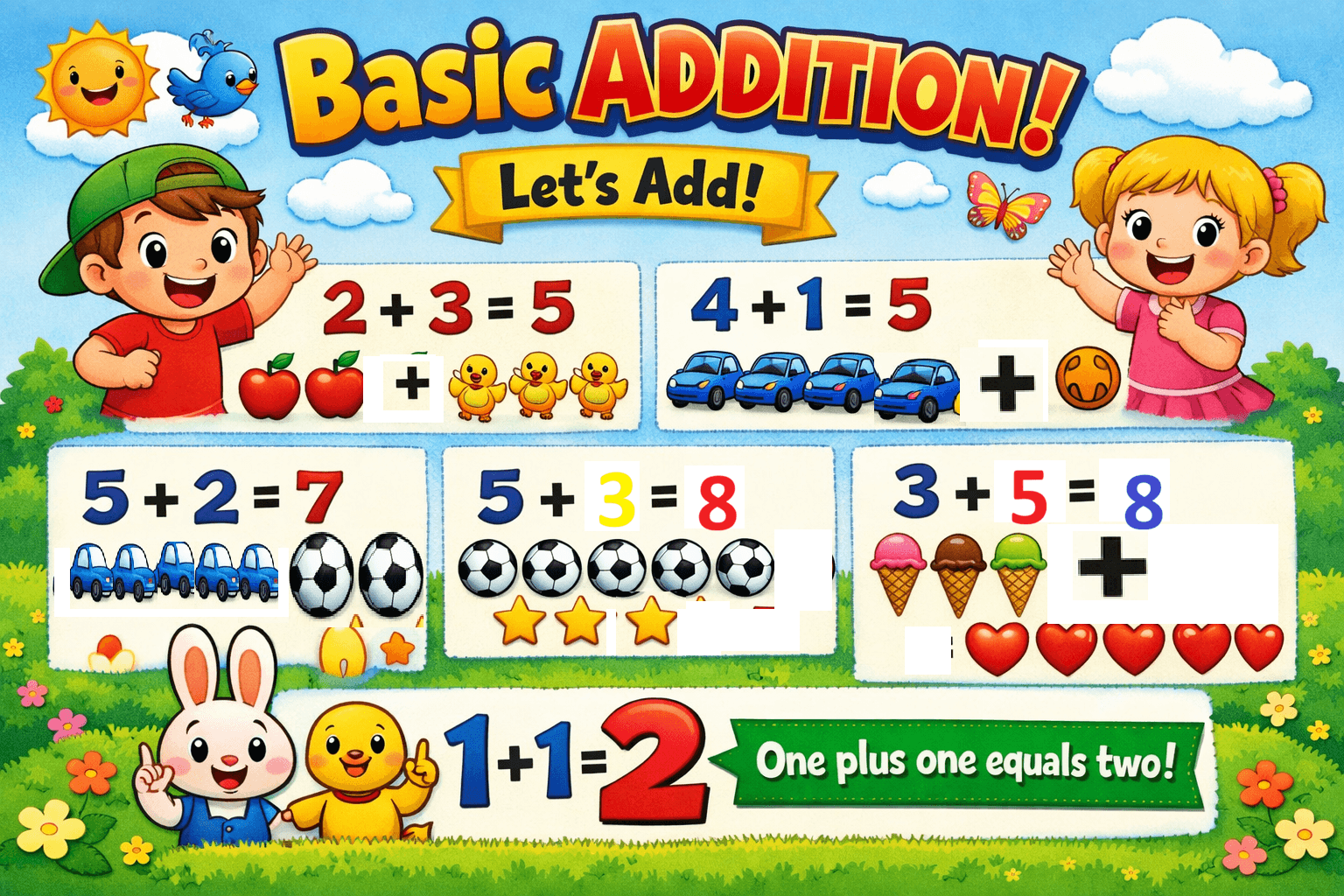
Mathematics becomes exciting when children begin to combine numbers and see how they grow. One of the first operations learners encounter is addition. Basic addition helps children understand how numbers work together and how quantities increase when objects are combined.
Loading cards...
What Is Basic Addition? 📚
Addition uses the plus sign (+) and the equal sign (=).
Example:
2 + 3 = 5
This means when we combine 2 objects and 3 objects, we get 5 objects in total.
Example with objects:
🍎🍎 + 🍎🍎🍎 = 🍎🍎🍎🍎🍎
2 apples + 3 apples = 5 apples
According to the National Council of Teachers of Mathematics, early exposure to addition helps children develop strong number sense and prepares them for more advanced mathematical concepts.
Parts of an Addition Problem 🔍
An addition sentence has three parts:
- Addends: the numbers being added
- Plus sign (+) and Equal sign: add symbol that shows that numbers are combined and equal symbol showing equivalence
- Sum: the answer or total
Example:
3 + 4 = 7
3 and 4 → addends
7 → sum
Let’s Practice Addition! 🎯
Try these simple activities to practice adding numbers.
1. Count and Add
Look at the pictures and add them together.
🍪🍪 + 🍪 = ?
Count them all!
Answer: 3 cookies
2. Finger Addition ✋
Use your fingers to solve the problem.
Show 2 fingers on one hand and 3 fingers on the other.
Now count all your fingers.
2 + 3 = 5
Try a Quick Challenge! 🧠
Can you solve these?
🍌🍌 + 🍌 = ?
4 + 1 = ?
3 + 2 = ?
Try counting objects around you and adding them together!
Why Learning Addition Is Important 🌟
Basic addition helps children:
- Understand how numbers combine
- Improve problem-solving skills
- Prepare for more advanced math concepts like subtraction and multiplication
Conclusion
Basic addition is an important building block in mathematics. By using everyday objects, fingers, and fun activities, children can easily understand how numbers combine to make larger numbers. With practice and interactive learning, addition becomes a skill that students can use both in school and in daily life.
References
- National Council of Teachers of Mathematics. (2000). Principles and Standards for School Mathematics.
- National Association for the Education of Young Children. (2020). Developmentally Appropriate Practice in Early Childhood Programs
- UNESCO. (2016). Early Childhood Care and Education Learning Framework.