Comparing Numbers: Understanding Which Number Is Bigger or Smaller
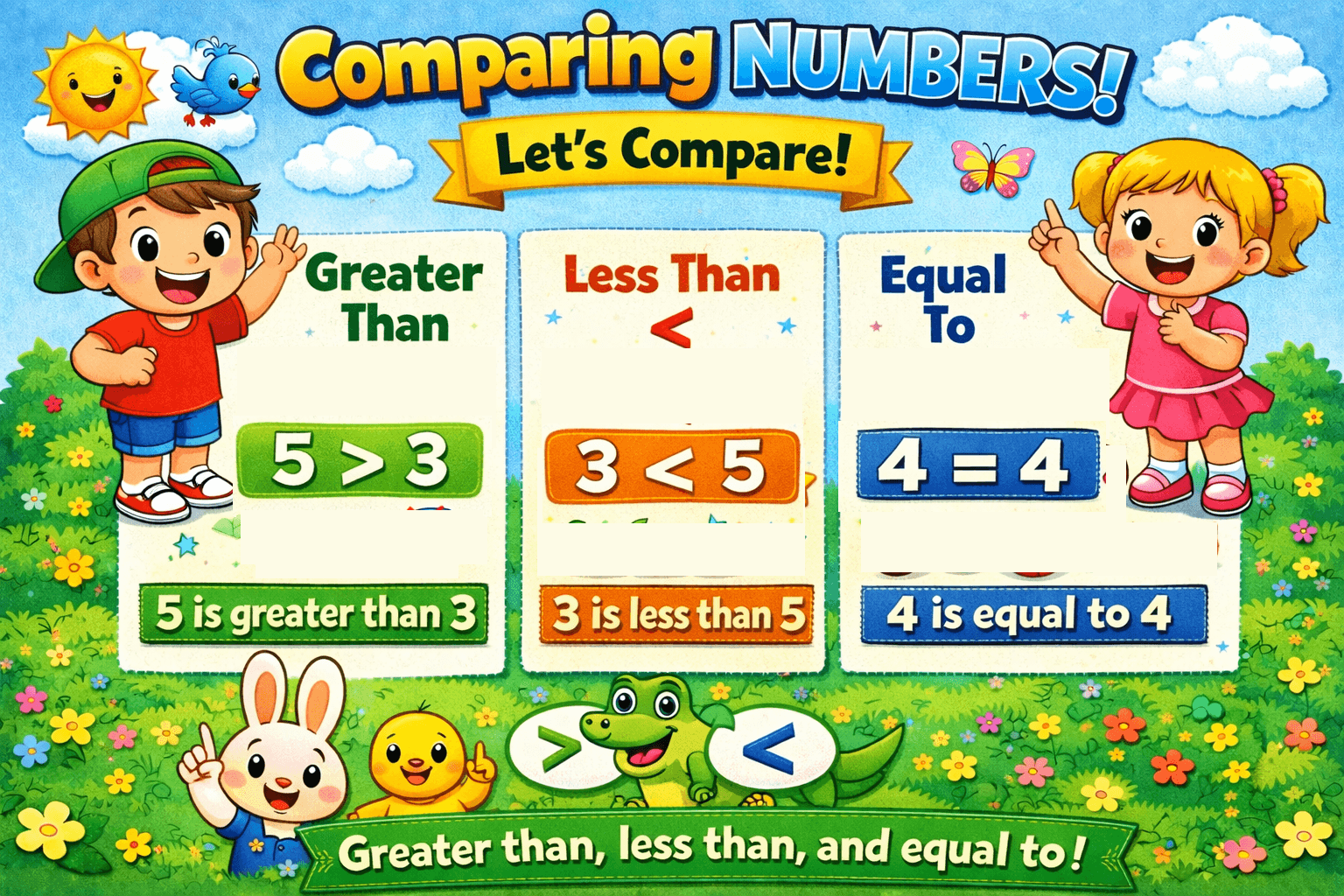
🔢⚖️ When children learn numbers, the next step is understanding how numbers relate to each other. One important math skill is comparing numbers. This helps learners identify which number is greater, smaller, or equal to another number. Comparing numbers is something we use in everyday life. For example, when sharing snacks, counting toys, or deciding who has more or fewer items.
Loading cards...
What Is Comparing Numbers? 📚
Comparing numbers means looking at two or more numbers to determine which one is greater, which one is smaller, or if they are equal.
We usually use special symbols when comparing numbers:
> means greater than
< means less than
= means equal to
Example:
5 > 3
This means 5 is greater than 3.
Example:
2 < 4
This means 2 is less than 4.
Example:
3 = 3
This means both numbers are equal.
Mathematics educators such as the National Council of Teachers of Mathematics explain that comparing numbers helps children build number sense and understand relationships between quantities.
Understanding Greater Than and Less Than 🔍
Greater Than (>)
A number is greater than another number if it represents a larger quantity.
Example:
6 > 2
Six is greater than two.
Example with objects:
🍎🍎🍎🍎🍎🍎 > 🍎🍎
Less Than (<)
A number is less than another number if it represents a smaller quantity.
Example:
2 < 5
Two is less than five.
Example with objects:
🍪🍪 < 🍪🍪🍪🍪🍪
Equal To (=)
Two numbers are equal when they represent the same amount.
Example:
4 = 4
Example with objects:
⭐⭐⭐⭐ = ⭐⭐⭐⭐
Let’s Practice Comparing Numbers! 🎯
1. Which Is Greater?
Look at the numbers:
3 and 5
Which one is greater?
Answer: 5 > 3
2. Which Is Less?
Compare the numbers:
2 and 6
Answer: 2 < 6
3. Compare the Objects
Objects -------------------------------- Comparison
🍎🍎🍎 and 🍎🍎🍎🍎 ------- 3 < 4
⭐⭐⭐⭐⭐ and ⭐⭐⭐ --- 5 > 3
⚽⚽⚽ and ⚽⚽⚽ ------------ 3 = 3
Why Comparing Numbers Is Important 🌟
Learning to compare numbers helps children:
→ Understand quantities and number relationships
→ Develop logical thinking skills
→ Prepare for advanced math concepts
The National Association for the Education of Young Children suggests that children learn these concepts best through visual examples, games, and hands-on activities.
Conclusion
Comparing numbers is an essential skill that helps children understand which numbers are greater, smaller, or equal. By practicing with numbers and real objects, learners can easily see the differences between quantities. With regular practice, comparing numbers becomes a simple and useful part of everyday math learning.
References
- National Council of Teachers of Mathematics. (2000). Principles and Standards for School Mathematics.
- National Association for the Education of Young Children. (2020). Developmentally Appropriate Practice in Early Childhood Programs.
- UNESCO. (2016). Early Childhood Care and Education Learning Framework.