Volume of Simple Shapes
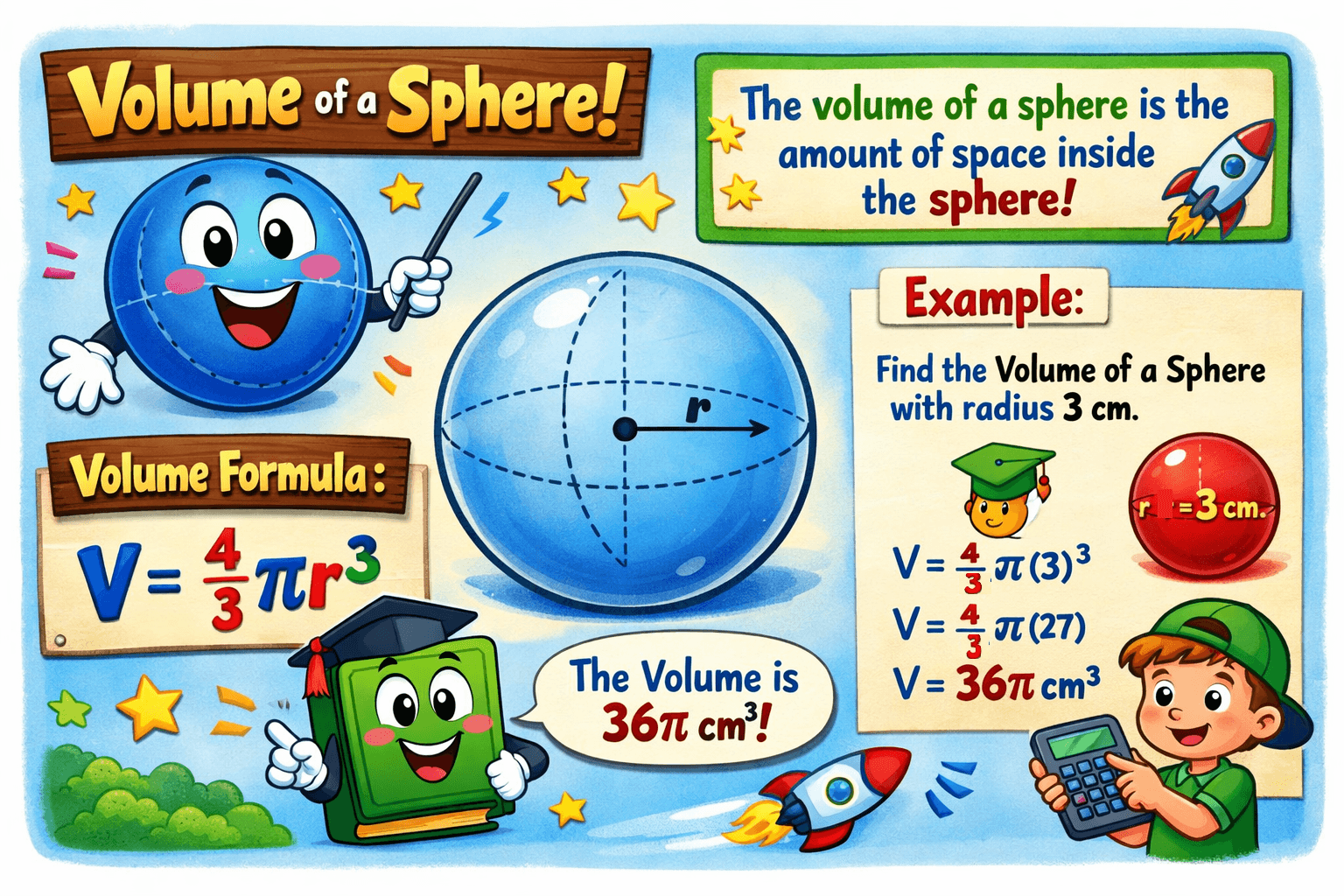
📦📐 Have you ever wondered how much space a box, cube, or container can hold? The amount of space inside a 3D object is called volume. Volume helps us measure how much something can contain, such as water in a bottle, sand in a bucket, or toys in a box.
Loading cards...
What Is Volume? 📚
Volume is the amount of space inside a three-dimensional object.
Examples of objects with volume:
● Boxes 📦
● Cubes 🎲
● Water bottles 🧴
● Storage containers 🗃️
Volume is usually measured in cubic units, such as:
● cubic centimeters (cm³)
● cubic meters (m³)
● cubic inches (in³)
Volume of a Cube 🎲
A cube has equal length, width, and height.
To find the volume of a cube, multiply the side length three times.
V = s^3
Where:
● V = volume
● s = side length
Example
If a cube has a side length of 3 cm:
3 × 3 × 3 = 27
Volume = 27 cubic centimeters (cm³)
Volume of a Rectangular Prism 📦
A rectangular prism looks like a box.
To find the volume, multiply:
● length
● width
● height
V = lwh
Where:
● l = length
● w = width
● h = height
Example
A box has:
● length = 5 cm
● width = 3 cm
● height = 2 cm
Volume:
5 × 3 × 2 = 30 cm³
Real-Life Examples 🌎
Volume helps us in everyday life.
Water Bottles
A bottle may hold 500 milliliters of water.
Storage Boxes
A bigger box has more volume, so it can store more toys.
Swimming Pools
Volume helps measure how much water a pool can hold.
Let’s Practice! 🎯
Problem 1
A cube has a side length of 4 cm.
What is the volume?
Answer:
4 × 4 × 4 = 64 cm³
Problem 2
A rectangular box has:
length = 6 cm
width = 2 cm
height = 3 cm
What is the volume?
Answer:
6 × 2 × 3 = 36 cm³
Problem 3
Which holds more volume?
Box A: 3 × 3 × 3
Box B: 4 × 2 × 2
Answer:
Box A = 27
Box B = 16
Box A holds more volume.
Why Learning Volume Is Important 🌟
Learning about volume helps children:
● Understand 3D shapes
● Measure capacity and space
● Solve real-world problems involving containers and storage
● Prepare for advanced topics in geometry
Conclusion
Volume tells us how much space is inside a 3D object. By learning how to calculate the volume of cubes and rectangular prisms, children can better understand shapes and measurements in everyday life.
References
- National Council of Teachers of Mathematics. (2000). Principles and Standards for School Mathematics.
- National Association for the Education of Young Children. (2020). Developmentally Appropriate Practice in Early Childhood Programs.
- UNESCO. (2016). Early Childhood Care and Education Learning Framework.