Basic Measurement: Learning to Measure the World
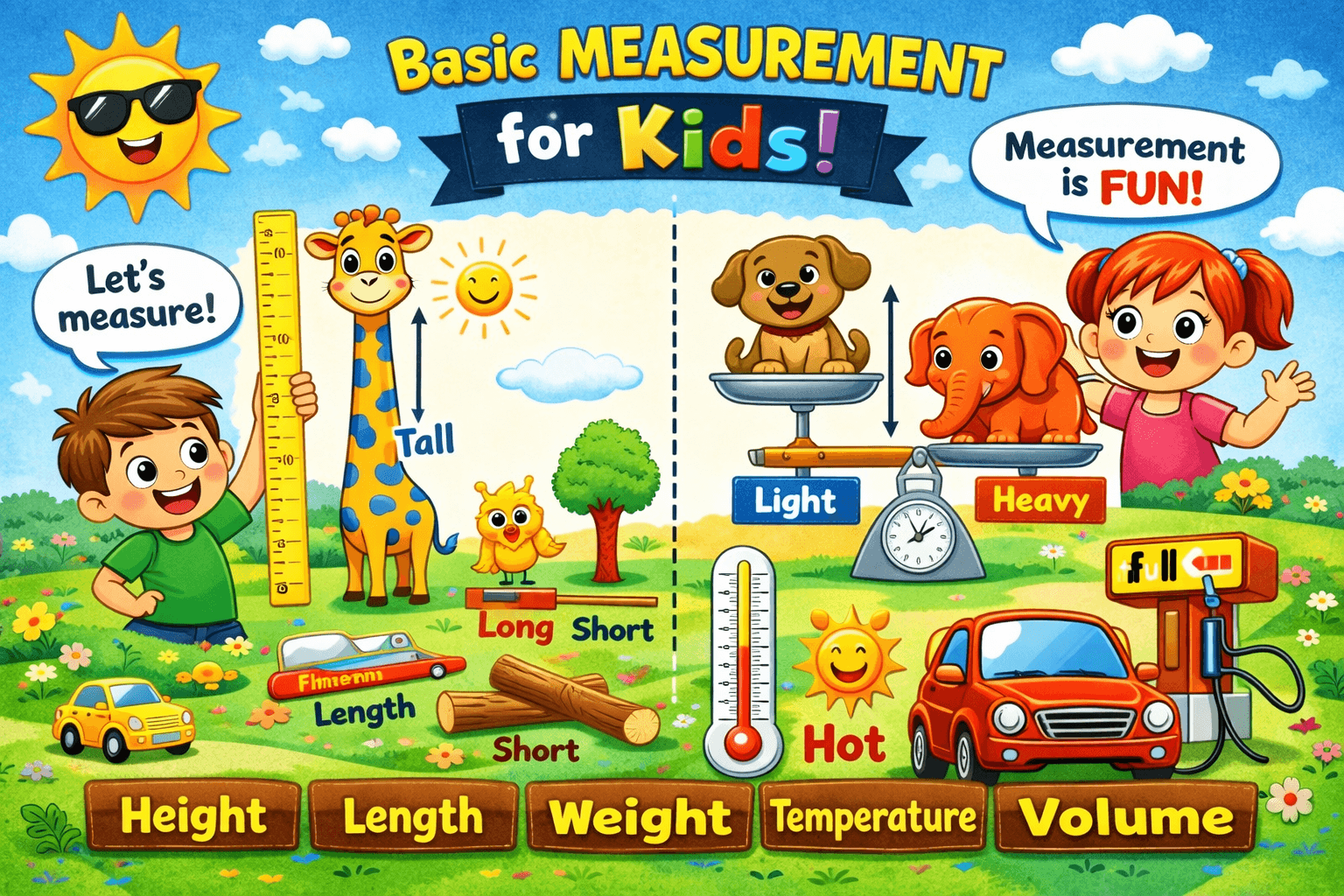
Have you ever wondered how tall you are, how long your pencil is, or how heavy your school bag feels? These questions involve something called measurement. Measurement helps us understand the size, length, height, weight, and amount of things around us. Learning about measurement helps children explore the world and compare objects in fun and meaningful ways.
Loading cards...
What Is Measurement? 📚
Measurement is the process of finding out the size, length, height, weight, or amount of something by using tools or comparing objects.
For example: Measuring how tall a plant is, finding how long a table is, and checking how heavy a backpack is
According to the National Council of Teachers of Mathematics, early measurement activities help children develop strong mathematical thinking and understand relationships between objects.
Types of Basic Measurement for Kids 🔍
1. Measuring Length 📏
Length tells us how long or short something is.
Examples:
a. A pencil is short.
b. A table is long.
Tools used for measuring length:
Ruler, Tape measure
Example:
✏️ Pencil → short
🪑 Table → long
2. Measuring Height 📐
Height tells us how tall or short something is.
Examples:
a. A tree is tall.
b. A chair is shorter.
Try comparing heights with friends!
3. Measuring Weight ⚖️
Weight tells us how heavy or light something is.
Examples:
a. A book is heavier than a pencil.
b. A feather is very light.
Tools used: Weighing scale
4. Measuring Capacity 🥛
Capacity tells us how much liquid a container can hold.
Examples:
a. A cup holds a small amount of water.
b. A bottle holds more water.
Try pouring water from one container to another to see the difference!
Let’s Try Some Fun Measurement Activities! 🎯
1. Compare Objects
Look at the objects below:
🖍️ Crayon and 📏 Ruler
Which one is longer?
Answer: The ruler is longer.
2. Heavy or Light?
Which object is heavier?
📚 Book or ✏️ Pencil
Answer: The book is heavier.
3. Tall or Short?
Compare the heights:
🌳 Tree and 🌼 Flower
Answer: The tree is taller.
Why Learning Measurement Is Important 🌟
Measurement helps children:
a. Compare objects and quantities
b. Understand size and distance
c. Develop observation and reasoning skills
The National Association for the Education of Young Children highlights that hands-on exploration helps young learners understand measurement concepts more effectively.
Conclusion
Measurement helps children explore and understand the world around them. By comparing lengths, heights, weights, and capacities, kids begin to see how math connects to everyday life. Through fun activities and simple tools, learning measurement can be both exciting and meaningful.
References
- National Council of Teachers of Mathematics. (2000). Principles and Standards for School Mathematics.
- National Association for the Education of Young Children. (2020). Developmentally Appropriate Practice in Early Childhood Programs.
- UNESCO. (2016). Early Childhood Care and Education Learning Framework.