Patterns for Kids: Discovering Repeating Designs
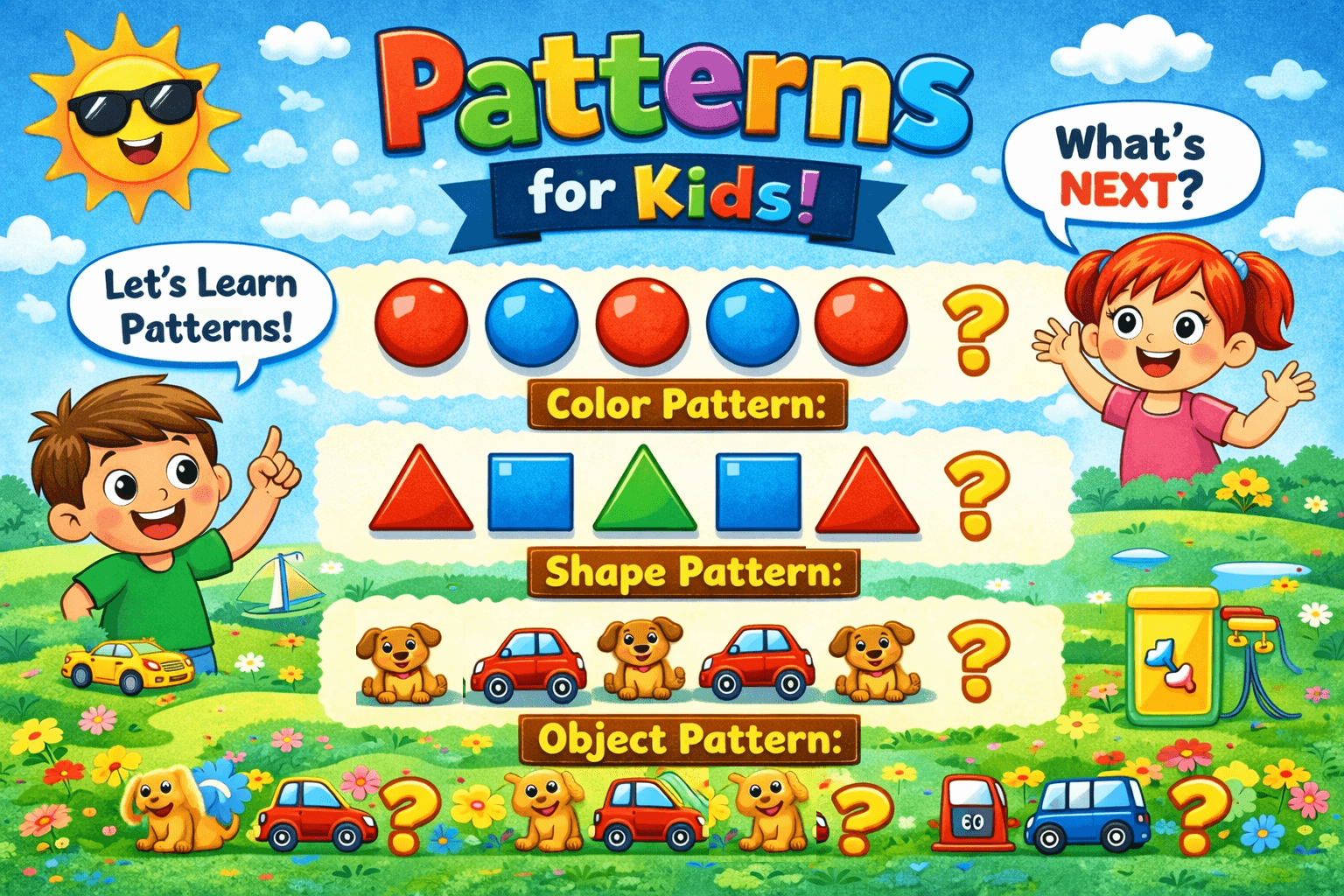
🔁✨🔁✨🔁✨ Have you ever noticed designs that repeat again and again? Maybe on your clothes, on tiles, or even in music? These repeating designs are called patterns. Learning about patterns helps children recognize order and understand how things repeat predictably. Patterns are one of the first mathematical ideas children explore, and they help build important skills in thinking, predicting, and problem-solving.
Loading cards...
What Are Patterns? 📚
A pattern is something that repeats in a regular and predictable way. Patterns can use shapes, colors, numbers, sounds, or movements.
Example of a simple pattern:
🔴 🔵 🔴 🔵 🔴 🔵
This pattern repeats red, blue, red, blue.
According to the National Council of Teachers of Mathematics, learning patterns helps children develop reasoning skills and prepares them for more advanced math concepts like algebra.
Types of Simple Patterns 🔍
1. Color Patterns 🎨
Patterns can repeat using colors.
Example:
🟡 🟢 🟡 🟢 🟡 🟢
The pattern repeats yellow, green.
2. Shape Patterns 🔺
Patterns can also use shapes.
Example:
🔺 🔵 🔺 🔵 🔺 🔵
Triangle, circle, triangle, circle.
3. Object Patterns 🍎
Patterns can be made using everyday objects.
Example:
🍎 🍌 🍎 🍌 🍎 🍌
Apple, banana, apple, banana.
Let’s Practice Patterns! 🎯
1. Complete the Pattern
⭐ ⭐ 🌙 ⭐ ⭐ 🌙 ___
What comes next?
Answer: ⭐
2. Find the Pattern
Look at this pattern:
🔺 🔵 🔺 🔵 🔺 🔵
What shape repeats?
Answer: Triangle and circle
3. Make Your Own Pattern
Try making a pattern using:
Colors
Shapes
Claps or sounds
Example:
👏 👏 👏 👣 👏 👏 👏 👣
Clap, clap, clap, stomp!
Pattern Challenge 🧠
Can you complete these patterns?
🔴 🔵 🔴 🔵 ___
🍪 🍪 🍩 🍪 🍪 🍩 ___
🔺 🔺 🔵 🔺 🔺 🔵 ___
Think about what repeats!
Why Learning Patterns Is Important 🌟
Patterns help children:
● Recognize order and repetition
● Improve observation skills
● Develop early problem-solving abilities
The National Association for the Education of Young Children emphasizes that pattern activities help children develop logical thinking and prepare them for future mathematical learning.
Conclusion
Patterns are all around us—in clothes, music, buildings, and nature. By exploring repeating colors, shapes, and objects, children learn to recognize patterns and predict what comes next. Through fun activities and games, learning patterns becomes an exciting part of early mathematics.
References
- National Council of Teachers of Mathematics. (2000). Principles and Standards for School Mathematics.
- National Association for the Education of Young Children. (2020). Developmentally Appropriate Practice in Early Childhood Programs.
- UNESCO. (2016). Early Childhood Care and Education Learning Framework.