Angles: Understanding Corners and Turns
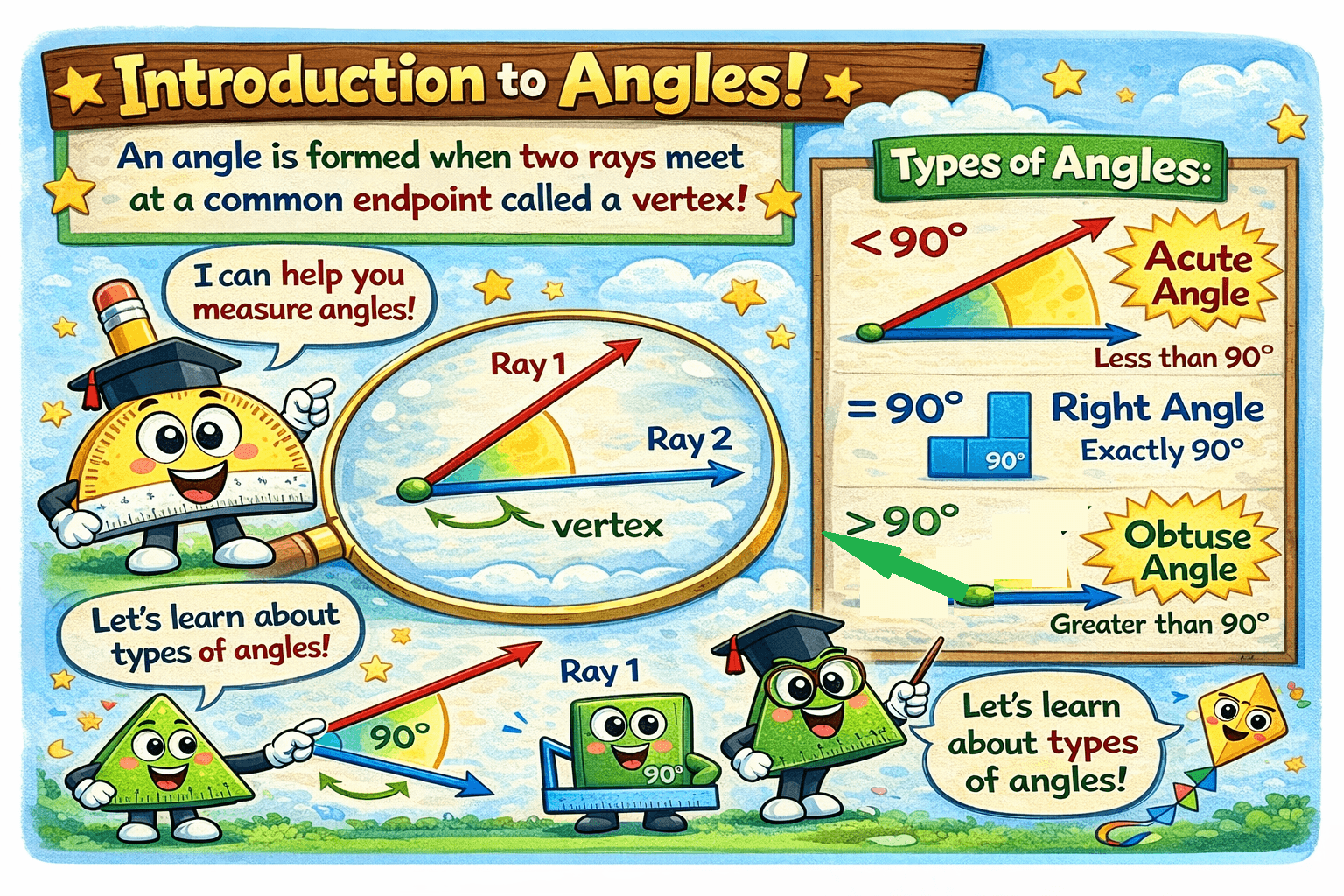
📐✨ Have you ever noticed the corners of a book, the hands of a clock, or the shape of a triangle? These corners and turns are called angles. Angles help us understand shapes, directions, and how lines meet in geometry.
Loading cards...
What Is an Angle? 📚
An angle is formed when two lines meet at a point.
The point where the two lines meet is called the vertex.
Example:
If you open a book slightly, the two covers form an angle.
Parts of an Angle 🔍
Every angle has three main parts:
Example: If two lines meet at point A, then A is the vertex of the angle.
| Part | Meaning |
|---|---|
| Vertex | The point where two lines meet |
| Arms (Sides) | The two lines forming the angle |
| Angle Opening | The space between the lines |
Measuring Angles 📏
Angles are measured in degrees (°).
A full circle contains:
360°
This means the circle turns completely around.
Types of Angles 🔺
There are different types of angles depending on how wide they open.
Acute Angle
● Less than 90°
● Small and narrow
Example: the tip of a pizza slice.
Right Angle
● Exactly 90°
Example: the corner of a book or a square.
Obtuse Angle
● More than 90° but less than 180°
Example: when a door is opened wide.
Straight Angle
● Exactly 180°
This looks like a straight line.
Angles in Everyday Life 🌍
Angles appear everywhere around us.
Examples:
● The hands of a clock
● The corner of a table
● The roof of a house
● The sides of triangles and squares
Learning angles helps children understand shapes and structures.
Problem 1 What type of angle is 90°? Answer: Right angle
Problem 2 Is 45° an acute or obtuse angle? Answer: Acute angle
Problem 3 What type of angle is 120°? Answer: Obtuse angle
Why Learning Angles Is Important 🌟
Understanding angles helps children:
●Recognize geometric shapes
●Understand directions and turns
●Prepare for advanced geometry and measurement
Conclusion
Angles are formed when two lines meet at a point. They can be small like acute angles, square like right angles, wide like obtuse angles, or straight like straight angles. By observing everyday objects and practicing measurements, children can easily understand and identify angles.
References
- National Council of Teachers of Mathematics. (2000). Principles and Standards for School Mathematics.
- National Association for the Education of Young Children. (2020). Developmentally Appropriate Practice in Early Childhood Programs.
- UNESCO. (2016). Early Childhood Care and Education Learning Framework.