Introduction to Decimals
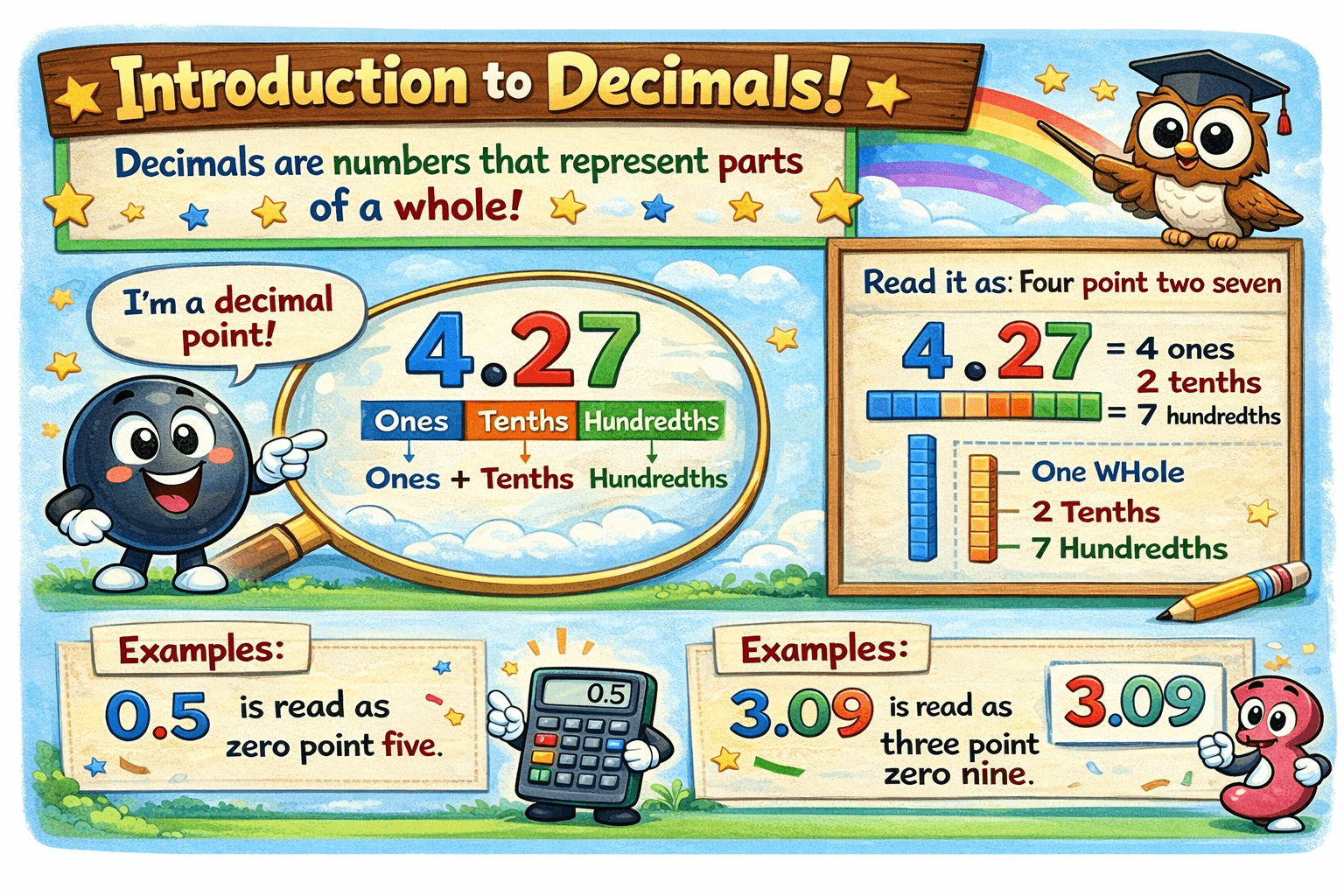
🔟✨ Numbers are not always whole numbers. Sometimes we need numbers that represent parts of a whole. These numbers are called decimals. Decimals help us describe things more precisely, especially in money, measurements, and everyday life.
Loading cards...
What Are Decimals? 📚
A decimal is a number that shows a whole number and a part of a whole.
Decimals use a decimal point (.) to separate the whole number from the fractional part.
Example:
3.5
3 = whole number
.5 = part of a whole
So 3.5 means 3 and a half.
The Decimal Point 🔍
The decimal point separates whole numbers from parts of a number.
Example:
12.7
| Place | Value |
|---|---|
| 1 | Tens |
| 2 | Ones |
| . | Decimal Point |
| 7 | Tenths |
This means: 12.7 = 12 and 7 tenths
Decimal Place Value 🔢
Decimals follow a place value system similar to whole numbers.
| Place Value | Example |
|---|---|
| Ones | 4 |
| Decimal Point | . |
| Tenths | 4.1 |
| Hundredths | 4.12 |
| Thousandths | 4.123 |
Example: 2.35 ● 2 = ones ● 3 = tenths ● 5 = hundredths
Decimals in Real Life 💰📏
Decimals are used every day.
Money
$1.50 means:
1 dollar
50 cents
Measurement
A pencil might measure:
12.5 centimeters
This means 12 centimeters and half a centimeter.
Let’s Practice! 🎯
Problem 1
Which number shows three and two tenths?
Answer:
3.2
Problem 2
What does 5.4 mean?
Answer:
5 and 4 tenths
Problem 3
Write the decimal for:
Seven and five tenths
Answer:
7.5
Why Learning Decimals Is Important 🌟
Decimals help children:
● Understand money and measurements
● Connect fractions with numbers
● Prepare for advanced math topics like percentages and algebra
Conclusion
Decimals help us describe numbers that are between whole numbers. By understanding the decimal point and place values like tenths and hundredths, children can read and use decimals in everyday situations such as money and measurements.
References
- National Council of Teachers of Mathematics. (2000). Principles and Standards for School Mathematics.
- National Association for the Education of Young Children. (2020). Developmentally Appropriate Practice in Early Childhood Programs.
- UNESCO. (2016). Early Childhood Care and Education Learning Framework.